In early March, my beautiful little church home was broken into and vandalized. The culprits took their time. They dismantled our soaring eagle lectern and broke our audio system. Candles were left burning down to nothing in their stands, and oil was spread all over the floor and altar. They left their mark on all of our most sacred places, including burns in the floor and chips in the prim wooden box where we store the wine and bread. The simple cross that stands on top of that box now bends back towards the organist while he plays. In short, they went after the light, the word, and our spiritual food. Among our many reactions and feelings, we know enough to be thankful that it was not a lot worse.
In the days that followed, we worked hard to make things right. We cleaned and repaired and secured. The efforts of many hands made a difference. On Sunday morning, we reopened our doors, re-consecrated our sacred space, and had our service. As we sang hymns and passed the peace, I was aware that while we had restored order and cleanliness, we had not gone back to the way things were. The damage is permanent, and it cannot be hidden, nor should it be. The damage to our church has a purpose. One, it serves to remind us both of the distress we felt on having our sacred space defiled, and of the love that surged from our local communities in response. Two, when we encounter a sacred place that is damaged and desecrated, we are called to see past that – to remember that it remains beautiful and that we must restore it to wholeness.
This ability to see the possibility of restoration – to envision the return to beauty – applies in the natural world where human activity has left an ugly mark. Consider the Nashua River. Once amongst the most polluted rivers in the United States, this river was restored through the work of multiple communities, under the leadership of Marion Stoddard, who refused to accept that it was beyond repair. She recently spoke at a forum in Fitchburg, MA where paper mills created the many-colored waters that flowed through towns like Ayer and Groton. During the forum the facilitator asked people to share their stories of the river and several lifelong residents of Fitchburg stood up each expressing the same sense of distance, even revulsion. One said that as a child and young adult, she never thought of the river as a river – it was nothing but stinking muck. Another person said that he had no interest in the river as a young man because he simply did not believe that it could be better. It was beyond hope, so why spend time and money on a lost cause? They had turned their back on the damaged river and the worse it got, the further they distanced themselves from its presence in their town.
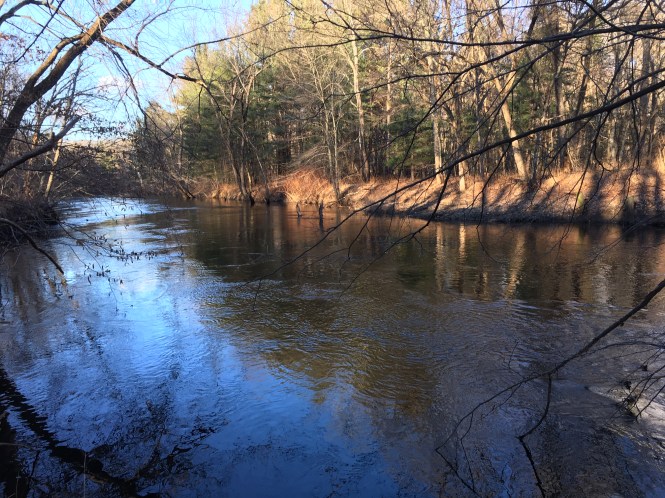
We then heard about the amazing 50 years of the Nashua River Watershed Association (NRWA) and the Nashua’s even more amazing designation earlier this year as a Wild and Scenic River. This federal status is ascribed to rivers of national importance in terms of culture, beauty, and wildness for the sake of present and future generations. In short, in only 50 years, the Nashua River has been restored from a 34-mile-long filthy dumping ground to a beautiful natural and recreational resource, and all because Marion Stoddard saw beyond the damage. She believed in restoration.
The Wild and Scenic Nashua River tells us that stories of restoration require stories of human transformation – of changing one’s mind and heart. Marion described the greatest challenge of her work was not in removing the source of the pollution or cleaning out the solid waste or even working with the State House, but in restoring people’s vision of the river as a place as a source of beauty, recreation, and life. Her vision included not just clean waters, but greenways so that people could have a direct relationship with the river – so they would not turn away. In changing the hearts of the people who lived along its banks, she taught them the value of the river, that it’s worth paying for restoration, and to ask for what you want, not what you are willing to settle for. Today, people live, work, and recreate along the river, and celebrate the greenway as a city landmark.
Even with all its beauty, the Nashua River will always bear witness to its difficult and damaged past. The people who love the Nashua today, including the people who fought for its Wild and Scenic status know they cannot reverse or eliminate the evidence of what the river has suffered. Permanent structures including dams and factory ruins tell the story of what it went through, what it had to survive, and how much work went into the change. Just as my church now has burns in the floor, these reminders have work to do. They remind us that new threats continue to impact the river including invasive species, nonpoint source pollution, and an increasingly ‘indoors’ generation. We still have work to do to change hearts and minds.
Additionally, rivers like the Nashua, and other stories of restoration inspire us to re-visit our perceptions of our role when we see damage in the natural world. How do we feel when a pregnant whale starves to death because her stomach is full of plastic? Does it change how we treat single use plastics? What is our call to action when increasingly strong storms impact people who are already vulnerable? Can we answer the call to climate action? Reversing the impacts of human industrialization is a big job, changing the way of the world takes faith in the future, vision and hope and people who will step forward to make real changes.
Marion saw and smelled muck, and believed in a clean flowing, swimmable, wild and scenic river. Marion knows that the ecosystems we live in need love, light, sustenance and our presence. Restoration does not just show the resiliency of nature, but the strength of the human mind and spirit to change the way we do things for current and future generations.
Quoted at the National Wild and Scenic River page (www.rivers.gov)
In the past 50 years, we have learned—all too slowly, I think—to prize and protect God’s precious gifts. Because we have, our own children and grandchildren will come to know and come to love the great forests and the wild rivers that we have protected and left to them . . . An unspoiled river is a very rare thing in this Nation today. Their flow and vitality have been harnessed by dams and too often they have been turned into open sewers by communities and by industries. It makes us all very fearful that all rivers will go this way unless somebody acts now to try to balance our river development.
– President Lyndon Johnson on signing the Wild & Scenic Rivers Act, October 2, 1968. (quoted at https://www.rivers.gov)
 outdoorfaiths